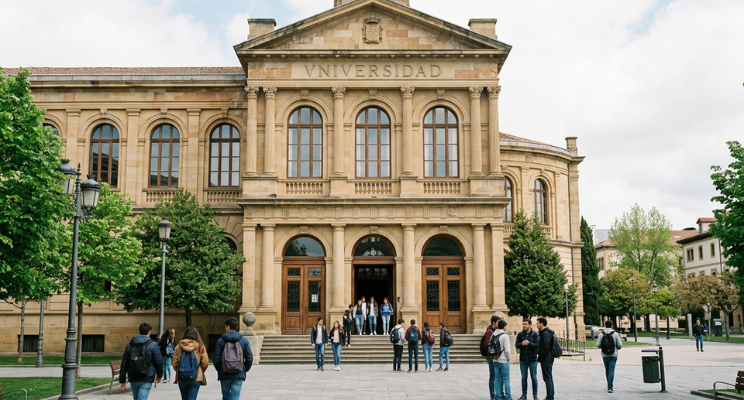
Study in Spain as an International Student: Universities, Admission, Visa and Pathways
Updated: Jun 24
Last updated: June 2026
Spain is one of the most attractive study destinations in Europe for international students who want to access high-quality higher education, experience life in a safe and culturally rich country, and build a future in an international academic environment.
For many students, studying in Spain is academically possible. The Spanish system offers different routes into universities, master’s degrees, vocational training programs and other higher education options. The real challenge is often not whether the student can study in Spain, but how to manage the admission route correctly.
In many cases, the most difficult part is administrative and bureaucratic: understanding which documents are needed, whether homologación, UNEDasiss or equivalence applies, how university admission works, whether entrance exams are useful or required, how deadlines vary, and how the student visa process fits into the academic calendar.
This guide explains how international students can study in Spain, what routes are available, what to check before applying, and how Campus Spain helps students transform a complex process into a clear, realistic and well-organized study plan.
Quick Answer: How Can International Students Study in Spain?
International students can study in Spain through different routes, including bachelor’s degrees, master’s degrees, vocational training programs and pathway programs such as Spanish LCA.
The basic academic logic is usually simple: students need to prove that their previous studies allow them to continue to the next academic level in Spain. For a bachelor’s degree, this usually means proving that secondary education gives access to university studies. For a master’s degree, it usually means proving that previous university studies allow access to postgraduate education.
The complexity appears in the administrative route: documents, recognition procedures, admission criteria, university calendars, public or private university requirements, regional differences, UNEDasiss, homologación, equivalence, possible entrance exams and student visa timing.
That is why the safest approach is not to guess. The best starting point is to review the student’s academic background, country of origin, target program, language level and documents, and then build a realistic study plan for Spain.
Why Study in Spain?
Spain offers international students a strong combination of academic quality, lifestyle, culture, safety, affordability and access to European higher education.
Students choose Spain because it can offer:
universities and higher education institutions with a wide range of programs;
bachelor’s degrees, master’s degrees, vocational training and pathway options;
public and private university routes;
study options in Spanish and, in some cases, English;
a European academic environment;
attractive cities for student life;
a strong cultural and language experience;
opportunities to learn Spanish, one of the most widely spoken languages in the world;
a welcoming lifestyle and a strong international student experience.
Spain is especially attractive for students who want more than a degree. It offers language, culture, professional possibilities, international exposure and a long-term connection with Europe.
The key is planning the route correctly. Spain is not an impossible system. It is a system that needs to be understood.

The Main Idea: Academic Access Is Achievable, but the Process Must Be Managed Correctly
Many international students and families approach Spain with the wrong question.
They ask: “Can I study in Spain?”
In many cases, the better question is: “What is the correct route for my profile?”
For most students, the challenge is not that Spain is academically closed. The challenge is that the process is fragmented.
Different universities, regions and programs may require different documents, deadlines and admission steps. Public universities and private universities do not always work in the same way. Bachelor’s and master’s degrees follow different procedures. Students from EU or equivalent education systems may have a different route from students from non-EU education systems. Some students may need homologación. Others may need UNEDasiss. Others may need equivalence. Some may benefit from entrance exams. Others may not need them at all.
This is why Spain can be an excellent destination, but a poor strategy can create unnecessary problems.
A good study plan should answer five questions:
What can the student study in Spain?
Which route is academically realistic?
Which documents are required?
Which universities or institutions are suitable?
How do admission, visa and arrival planning fit together?
Main Routes to Study in Spain
International students do not all follow the same route. The best option depends on the student’s academic profile, objectives, language level and timeline.
Student goal | Possible route in Spain | Key points to check |
Spanish preparation + admission strategy | Spanish LCA pathway | Spanish language, adaptation, admission planning, documents, visa preparation and transition to higher education |
Bachelor’s degree | Public or private university | Secondary education, homologación or UNEDasiss, admission score, possible PCE/EBAU, language, deadlines |
Master’s degree | Official university master’s, private master’s or other postgraduate route | Previous university degree, academic fit, habilitante or non-habilitante status, equivalence or recognition requirements |
Vocational training / FP | Higher vocational training program | Access requirements, places available, practical orientation, employability, language and visa suitability |
Not sure yet | Academic orientation first | Student profile, realistic options, country-specific requirements, documents and long-term goals |
The most important step is choosing the route before starting the paperwork. If the route is wrong, the student may waste time preparing documents or exams that are not useful for their real objective.
Spain Does Not Have One Single Admission Process
One of the most important things international students should understand is that Spain does not have one single admission process for every student.
Admission may depend on:
whether the student applies to a public or private university;
whether the student wants a bachelor’s degree or a master’s degree;
the student’s previous education system;
whether the student comes from an EU, equivalent or non-EU education system;
the Autonomous Community where the university is located;
the university’s own admission rules;
the degree selected;
the student’s grades;
whether the program is taught in Spanish or English;
whether homologación, UNEDasiss, equivalence or other recognition procedures apply;
whether entrance exams are required, useful or unnecessary;
the student visa timeline, if the student is non-EU.
This may sound complex, but it also creates opportunities.
Because there are different routes, many students can find a viable path if their profile is analyzed correctly. A student who may not be competitive in one university, region or degree may have a better option in another institution or admission route.
The goal is not to make the process look difficult. The goal is to avoid mistakes.
Public and Private Universities in Spain
Spain has both public and private universities. Both can be valid options for international students, but they often work differently.
Public universities usually have more formal admission procedures, fixed calendars and competitive admission systems, especially for bachelor’s degrees. In many public university bachelor’s programs, admission is strongly connected to the student’s academic score and the number of available places.
Private universities usually have their own admission criteria. They may use interviews, internal tests, academic review, language requirements or other selection methods. They may also have more flexible admission calendars, although this does not mean students can apply at the last minute without preparation.
For international students, the right choice is not always “public is better” or “private is easier.” The right choice depends on:
the student’s academic record;
the target degree;
the competitiveness of the program;
the student’s budget;
the language of instruction;
the city;
the admission calendar;
the visa timeline;
the student’s long-term goals.
In some cases, a public university may be the best option. In others, a private university may offer a clearer or more realistic route. In other cases, Spanish LCA or another pathway may be the best bridge before starting higher education.
Bachelor’s Degrees in Spain
A bachelor’s degree is usually the main route for students who have completed secondary education and want to begin university studies in Spain.
The basic academic principle is straightforward: the student must show that their previous secondary education allows access to university studies.
The administrative route, however, depends on the student’s education system and the university where they want to apply.
For bachelor’s degree admission, students may need to check:
whether their secondary education gives access to university studies in Spain;
whether they need homologación to the Spanish Bachillerato;
whether they need a UNEDasiss credential;
whether their university requires PCE, EBAU or other admission criteria;
whether their grades are competitive enough;
whether they need to prove a specific Bachillerato modality;
whether the degree is taught in Spanish or English;
whether the university has a special admission period for international students;
whether the deadline is regional, university-specific or program-specific.
A bachelor’s degree in Spain usually requires more careful planning than many students expect. This is not because Spain is closed to international students, but because the admission route has to be matched correctly to the student’s academic background.
For a deeper explanation, read: Bachelor’s Degree in Spain: Requirements for International Students.
EU, Equivalent and Non-EU Education Systems
Not all international students follow the same academic recognition route.
Students from EU education systems, the International Baccalaureate, the European Baccalaureate or countries with applicable reciprocity agreements may follow a more direct route in many cases. These students often use UNEDasiss to obtain an access credential and admission score.
Students from non-EU education systems without applicable reciprocity agreements may need a different route. For bachelor’s degree access, they may need homologación of their secondary studies to the Spanish Bachillerato, together with other admission requirements depending on the university and region.
This distinction is essential.
Two students may both be international students, but they may need different documents, different procedures and different timelines.
That is why students should not copy another student’s process without checking whether their academic system, country and target university are the same.
Homologación, UNEDasiss and Equivalence: What Is the Difference?
This is one of the most important parts of the process, and also one of the most confusing.
International students often use the words homologación, equivalence and UNEDasiss as if they were the same thing. They are not.
Each one has a different purpose.
Homologación
Homologación is an official recognition procedure. For bachelor’s degree access, it is especially relevant for students from certain non-EU secondary education systems who need their secondary studies recognized as equivalent to the Spanish Bachillerato.
In practical terms, homologación can confirm that the student’s previous secondary education gives access to continue studies in the Spanish education system.
For students applying to bachelor’s degrees, homologación can be one of the key administrative steps. It is not a university admission strategy by itself. It is a recognition procedure that may be needed before or during the admission process.
Students should also understand that homologación can take time. In some cases, students may be able to use a conditional homologación document while the final decision is pending, but this depends on the admission process and the university’s requirements.
The safest approach is to check early whether homologación is required for the student’s profile and target route.
UNEDasiss Credential
UNEDasiss is a service used in many bachelor’s degree admission processes in Spain for international students.
Through UNEDasiss, students may obtain an accreditation or credential that can include different services, such as:
verification of access requirements;
calculation or conversion of admission grade;
Bachillerato modality;
PCE exams;
EBAU-related services in some cases;
recognition of subjects taken in foreign education systems;
language accreditation.
This means UNEDasiss is not only “one document.” It can include different services depending on the student’s route and the university’s requirements.
Some students may need only a basic credential. Others may need PCE exams, modality recognition or additional services. Some universities may accept certain UNEDasiss services while others may have their own criteria.
The important point is this: students should not request UNEDasiss services randomly. They should first check what their target universities require.
Equivalence
Equivalence is mainly relevant for higher education degrees, especially when a student has already completed university studies abroad and wants those studies recognized at an academic level in Spain.
For master’s access, equivalence may be relevant depending on the type of master’s degree and the university’s requirements.
However, equivalence is not the same as homologación. It does not always produce the same legal or professional effects. In many cases, equivalence recognizes an academic level but does not necessarily grant access to a regulated profession.
A Simple Way to Understand It
Concept | Usually relevant for | Main purpose |
Homologación | Often relevant for non-EU secondary studies and some regulated university/professional routes | Official recognition of foreign studies as equivalent to a Spanish qualification or academic level |
UNEDasiss credential | Bachelor’s degree admission | University access credential, grade calculation, PCE/EBAU services, modality or other admission-related services |
Equivalence | Higher education degrees, especially for some master’s or academic recognition cases | Recognition of an academic level without necessarily matching one exact Spanish professional qualification |
The right process depends on the student’s country, previous studies, target degree, university and professional objective.
This is why document strategy is one of the most important parts of studying in Spain.
PCE, EBAU and Entrance Exams: Are They Always Required?
No. Entrance exams are not always required to study in Spain.
This is one of the most important messages for international students.
Some students arrive believing that they must always prepare exams such as PCE, EBAU or Selectividad. Others believe they will never need exams. Both assumptions can be wrong.
In reality, entrance exams may be:
required by the university or admission route;
useful to improve the student’s admission score;
unnecessary if the student has another valid admission route;
irrelevant for some private university or special admission procedures;
strategically useful only for certain degrees with high competition.
For bachelor’s degree admission, the decision depends on the student’s education system, the university, the Autonomous Community, the degree and the student’s target admission score.
For some students, preparing PCE exams can be essential. For others, it may be a waste of time if the chosen route does not require them or if another option is more realistic.
A strong admission strategy does not start by asking, “Which exams should I take?”
It starts by asking:
Which degree do I want?
Which universities are realistic?
What score do I have?
What admission route applies to my education system?
Can exams improve my chances?
Do I have time to prepare them properly?
Should I also apply through alternative routes?
The goal is not to avoid exams at all costs. The goal is to use them only when they make sense.
Admission Scores, Nota de Corte and Competition
Many public university bachelor’s programs in Spain use admission scores to assign places.
The nota de corte is the score of the last student admitted to a specific degree in the previous admission process. It is not a fixed requirement, but it is a useful reference.
A degree with a high nota de corte is usually more competitive. A degree with a lower nota de corte may be more accessible, although this can vary every year depending on demand.
International students should not only ask whether they are academically eligible. They should also check whether their admission score is competitive for the target degree.
This matters especially in selective fields such as:
Medicine;
Dentistry;
Nursing;
Psychology;
Engineering;
Computer Science;
Business;
International Relations;
Architecture;
other high-demand programs.
However, a student who is not competitive for one specific degree or city may still have good options elsewhere in Spain. Spain has many universities, regions and academic routes.
This is where strategy matters.
Special Admission Routes for International Students
Some universities or regions may offer specific admission periods, early admission procedures or special routes for international students.
These routes can be very valuable because they may offer students a clearer or earlier opportunity to apply.
Depending on the institution, a special admission route may:
open before the ordinary admission period;
be designed specifically for international students;
have different document requirements;
evaluate the student’s academic record without requiring the same exams as other routes;
reserve a limited number of places;
require the student to submit pending documents later;
depend on order of application, available places or program demand.
These opportunities can be excellent, but they are not universal. They vary by university, region and year.
International students should not assume that every Spanish university has the same special admission process. They should also not assume that because one student was admitted through a specific route, the same route will work for them.
Campus Spain’s role is to identify which routes exist, which are realistic and which should be prioritized.
Master’s Degrees in Spain
Master’s degree admission is usually different from bachelor’s degree admission.
Students applying for a master’s degree normally need to have completed previous university studies. The university will review whether the student’s academic background is suitable for the program.
Common requirements may include:
university diploma;
academic transcript;
proof that the degree gives access to postgraduate studies;
passport;
CV;
motivation letter;
recommendation letters;
language certificate;
interview;
previous professional experience, in some cases;
official translations or legalization, when required.
The process is often managed by the university, faculty, department or program committee.
For international students, the most important distinction is whether the master’s degree is habilitante or non-habilitante.
Habilitante Master’s Degrees
A habilitante master’s degree gives access to a regulated profession in Spain.
These programs may require more formal recognition of the previous university degree. Depending on the student’s country and qualification, homologación or equivalence procedures may be necessary.
This route can be more complex and should be analyzed carefully before applying.
Non-Habilitante Master’s Degrees
A non-habilitante master’s degree does not directly qualify the student for a regulated profession in Spain.
In many cases, the university itself can evaluate the student’s previous foreign degree to decide whether it allows access to the master’s program. This does not necessarily mean that the student’s degree is officially homologated in Spain. It may only allow access to that specific master’s program.
This distinction is important.
A student may be admitted to a master’s degree without having full professional recognition of their previous degree in Spain. But if the student’s long-term goal involves a regulated profession, the recognition route must be checked separately.
Vocational Training and FP in Spain
Vocational training, often known in Spain as Formación Profesional or FP, can also be a strong option for international students.
FP programs are usually more practical and professionally oriented than traditional university degrees. They can be especially interesting for students who want a clearer connection between studies and employability.
Depending on the student’s profile, FP may be relevant in areas such as:
business and administration;
information technology;
healthcare;
hospitality and tourism;
marketing;
logistics;
education support;
technical and industrial fields.
FP should not be seen as a lower option. For some students, it can be a more realistic, practical and employability-focused route than applying directly to a highly competitive university degree.
However, students still need to check access requirements, available places, language, documentation, visa eligibility and future progression opportunities.
Spanish LCA and Pathway Programs
Some international students are not ready to enter a Spanish university or higher education program directly.
They may need time to improve their Spanish, understand the education system, adapt to life in Spain, prepare documents, define their academic strategy or complete the steps required for admission.
For these students, a pathway program such as Spanish LCA can be a very useful route.
Spanish LCA is Campus Spain’s pathway program for international students who want a guided route toward university, vocational training or other higher education options in Spain.
It is not simply a Spanish language course. Its value is that it combines:
Spanish language preparation;
cultural adaptation;
university environment;
academic orientation;
admission strategy;
guidance on homologación, equivalence and UNEDasiss;
visa preparation;
support with accommodation, health insurance and arrival planning;
transition toward a suitable higher education route in Spain.
For some students, direct admission may be the best route. For others, Spanish LCA can provide the time, structure and support needed to prepare the next step properly.
The goal is not to send every student through the same pathway. The goal is to identify the safest and most realistic route for each student.
Read more here: Spanish LCA: A Guaranteed Pathway to Higher Education in Spain.
Language Requirements: Spanish or English?
International students can study in Spain in Spanish, English or, in some cases, bilingual programs.
However, the language of instruction depends on the institution and program.
Mainly, bachelor’s degrees in public universities are taught in Spanish. Some private universities and business schools offer more programs in English. Master’s programs may be available in Spanish, English or both.
Students should check:
the language of instruction;
whether a language certificate is required;
whether the university requires a specific level;
whether Spanish is needed for daily life;
whether the student can realistically follow academic classes in that language;
whether Spanish will be needed for internships, professional practice or future opportunities.
Even when a program is taught in English, Spanish can still be important for daily life, integration, internships, administrative procedures and long-term opportunities in Spain.
Students who do not yet have the required level of Spanish may need a preparation route before entering higher education. This is one of the reasons why Spanish LCA can be useful for some profiles.
Tuition Fees: Public Does Not Always Mean the Same Price for Everyone
Spain is often attractive because public university tuition can be more affordable than in many other countries.
However, international students should understand that fees can vary.
The cost may depend on:
whether the university is public or private;
the Autonomous Community;
the degree;
whether the student is EU or non-EU;
whether the student has residence status;
the number of credits;
whether the program is bachelor’s, master’s or another route.
In some cases, non-EU students may pay higher public university fees than Spanish or EU students. This does not mean Spain is not affordable. It means students should check the real cost of their specific route before making a decision.
A good study plan should include both academic feasibility and financial planning.
When Should International Students Apply?
International students should start planning early.
A safe timeline is usually several months before the intended start date. In many cases, students should begin preparing between 6 and 12 months in advance, especially if they need document legalization, translations, homologación, UNEDasiss, university applications and a student visa.
Late planning is one of the biggest risks.
Students often underestimate how long it can take to:
collect academic documents;
legalize or apostille documents;
translate documents officially;
understand admission requirements;
apply to universities;
wait for admission results;
prepare a student visa file;
book a visa appointment;
arrange accommodation;
travel to Spain.
The academic process and the visa process should not be treated separately. They are connected. If the academic process is delayed, the visa process can also be delayed.
For more detail, read: When to Apply to Universities in Spain as an International Student.
Student Visa and Immigration Planning
Many non-EU students need a student visa to study in Spain.
Visa requirements may vary depending on the student’s country of residence, consulate, program, duration of studies and personal circumstances.
Students commonly need to prepare documents related to:
admission to a recognized study program;
passport;
financial means;
health insurance;
accommodation;
academic documents;
criminal record certificate, when applicable;
medical certificate, when applicable;
visa application forms and consular requirements.
Students should always check the requirements of the Spanish consulate responsible for their place of residence.
The student visa should not be left until the last minute. Even if the student has an admission letter, the visa process can require time, organization and careful document preparation.
Campus Spain helps students organize the visa preparation process according to their program, country and consulate requirements.
For a general overview, read: Student Visa Spain Overview: What International Students Usually Need.
Accommodation, Health Insurance and Arrival
Studying in Spain is not only about admission.
Students also need to prepare the practical side of moving to a new country.
This may include:
finding accommodation;
arranging health insurance;
planning arrival dates;
understanding immigration requirements after arrival;
preparing for TIE/NIE procedures when applicable;
opening a bank account when possible or necessary;
adapting to a new city;
understanding local transport, schedules and daily life.
These practical steps can create stress for students and families if they are not planned in advance.
A complete study plan should include both academic and practical preparation. A student who receives admission but arrives without housing, insurance or immigration planning may still face serious difficulties.
How to Choose the Right University or Program
Choosing where to study in Spain should not be based only on rankings, city preference or the name of the university.
International students should consider:
whether the program matches their academic background;
whether admission is realistic;
whether the language of instruction is suitable;
whether the student’s grades are competitive;
whether the university requires specific documents or exams;
whether the city is affordable and suitable;
whether the program has good academic or professional outcomes;
whether the student can complete the visa process on time;
whether the route fits the student’s long-term goals.
The best university is not always the most famous one. The best choice is the one that is academically suitable, realistic, legally viable and aligned with the student’s future plans.
Common Mistakes to Avoid
International students often make avoidable mistakes when planning to study in Spain.
The most common mistakes include:
Thinking Spain has one single admission process for all students.Admission can vary depending on university, region, degree, education system and student profile.
Assuming academic access and administrative admission are the same thing.A student may be academically eligible but still need to complete document, recognition and admission procedures correctly.
Assuming entrance exams are always required.Some students may need exams, but others may have different routes.
Assuming entrance exams are never required.For some degrees and universities, exams can be necessary or strategically important.
Starting the process too late.Documents, translations, applications and visa preparation can take longer than expected.
Choosing a degree without checking admission score or requirements.A student may like a degree but not meet the admission conditions or score expectations.
Confusing homologación, UNEDasiss and equivalence.These are different procedures and should not be used interchangeably.
Preparing the visa after the academic process is already delayed.Visa timing should be part of the study plan from the beginning.
Choosing a program only because it is in English.Language is important, but academic fit, admission and future goals matter too.
Trying to manage everything without understanding the Spanish system.Spain can offer excellent opportunities, but the process requires careful planning.
How Campus Spain Helps International Students Study in Spain
Campus Spain helps international students understand their real options and build a structured route toward higher education in Spain.
The process usually starts with academic orientation. This means reviewing the student’s background, documents, interests, language level and objectives before recommending a route.
Campus Spain can help students with:
academic orientation;
university and program selection;
admission strategy;
bachelor’s, master’s and FP routes;
Spanish LCA pathway;
homologación, equivalence and UNEDasiss guidance;
entrance exam strategy when relevant;
student visa preparation;
health insurance;
accommodation planning;
arrival support;
immigration requirements after arrival.
The goal is not to send every student to the same institution or the same program. The goal is to design a realistic, suitable and well-organized study plan for Spain.
For some students, that may mean direct admission to a university. For others, it may mean Spanish LCA first. For others, FP or a different higher education route may be more realistic.
The value of Campus Spain is that students and families do not have to understand the Spanish system alone.
Frequently Asked Questions
Can international students study in Spain?
Yes. International students can study in Spain through different routes, including bachelor’s degrees, master’s degrees, vocational training programs and pathway programs. The correct route depends on the student’s previous studies, country of origin, academic documents, language level, target program and visa situation.
Is it difficult to access university in Spain as an international student?
Academically, access to Spanish higher education can be straightforward when the student has completed the previous academic level and chooses a realistic route. The main difficulty is usually administrative: understanding documents, recognition procedures, admission calendars, university requirements and visa timing.
Is Spain a good country for international students?
Yes. Spain can be an excellent destination for international students because it offers European higher education, cultural diversity, attractive cities, academic options, language learning and a strong student experience.
Can I study in Spain in English?
Yes, some programs in Spain are taught in English, especially at private universities, business schools and some master’s programs. However, many bachelor’s degrees, especially in public universities, are taught mainly in Spanish. Students should always check the language of instruction before applying.
Do I need Spanish to study in Spain?
It depends on the program. If the program is taught in Spanish, students will usually need enough Spanish to follow classes. If the program is taught in English, Spanish may not be required academically, but it is still very useful for daily life, integration and future opportunities in Spain.
Do international students need entrance exams in Spain?
Not always. Some students may need entrance exams, some may use them to improve their admission score, and others may not need them at all. The answer depends on the student’s academic background, target university, degree and admission route.
What is homologación?
Homologación is an official recognition procedure. For bachelor’s degree access, it is often relevant for students from certain non-EU secondary education systems who need their previous studies recognized as equivalent to the Spanish Bachillerato.
What is UNEDasiss?
UNEDasiss is a service used in many bachelor’s degree admission processes in Spain for international students. It can provide access verification, grade calculation, PCE or EBAU-related services, modality recognition, subject recognition or language accreditation depending on the student’s needs and the university’s requirements.
What is equivalence?
Equivalence is a recognition procedure usually related to higher education degrees. It may recognize an academic level without necessarily matching the foreign degree to one exact Spanish qualification or granting access to a regulated profession.
Can I study in Spain without knowing which university to choose?
Yes, but you should not apply without a strategy. Many students first need academic orientation to understand which universities, degrees or routes are realistic for their profile. Campus Spain helps students compare options and build a study plan before applying.
What is Spanish LCA?
Spanish LCA is Campus Spain’s pathway program for international students who need a guided route toward higher education in Spain. It combines Spanish preparation, cultural adaptation, academic orientation, admission strategy, visa preparation and support with practical arrival steps.
Do I need a student visa to study in Spain?
Many non-EU students need a student visa to study in Spain. The exact requirements depend on the student’s country, program and consulate. Students should prepare the visa process carefully and with enough time.
When should I start the process?
In many cases, international students should start planning 6 to 12 months before the intended start date. This gives time to prepare documents, translations, applications, admission, homologación, UNEDasiss, visa requirements, accommodation and arrival planning.
Can Campus Spain help me study in Spain?
Yes. Campus Spain helps international students understand their options, design a realistic admission strategy and prepare the academic, administrative and practical steps needed to study in Spain.
Need Help Planning Your Study Route in Spain?
Studying in Spain can be an excellent opportunity. For many international students, the academic route is possible, but the process must be planned correctly.
Your best route will depend on your academic background, country of origin, target program, language level, documents, deadlines and visa situation.
Campus Spain helps international students understand their real options, design a realistic admission strategy and prepare the academic, administrative and practical steps needed to study in Spain.
Contact Campus Spain to review your profile and start building your study plan for Spain.
Related Guides
If you are planning to study in Spain, these guides can help you understand the process in more detail:
Study in Spain as an International Student: Universities, Admission, Visa and Pathways
Spanish LCA: A Guaranteed Pathway to Higher Education in Spain
Bachelor’s Degree in Spain: Requirements for International Students
When to Apply to Universities in Spain as an International Student
Student Visa Spain Overview: What International Students Usually Need
How to Choose a University in Spain as an International Student
© 2026 Campus Spain. This article is original content created by Campus Spain. Reproduction, redistribution, translation, adaptation or use of this content for commercial purposes is not permitted without prior written authorization.